Almost everyone in the Netherlands has held one at some point, and almost nobody knows what it actually is. A Delft blue tile is not porcelain, it did not originally come from the Netherlands, and the blue is not even blue while it is being painted. Here is what a tile really is, how it was made four centuries ago, and the ways you can make one yourself today.
Not porcelain, but earthenware with a tin glaze
The most stubborn myth first: Delft blue is not porcelain. It is ordinary earthenware — fired clay — with a layer of tin glaze over the top. That glaze is white and opaque, and that is exactly the point: it covers the reddish clay underneath completely and gives you a bright white surface to paint on.
That was not an aesthetic choice but a workaround. Around 1602 Chinese porcelain began arriving in the Netherlands via the VOC, blue on white, and it cost a fortune. Dutch potters could not make porcelain — the recipe was not cracked in Europe until around 1709 — so they did the next best thing: they imitated the look on a material they did have a handle on. The Dutch Tile Museum puts it drily: the potters “tried to copy Chinese porcelain and transferred the decorations onto earthenware”.
So Delft blue began as imitation. Only gradually did it become a style of its own, with its own subjects, and eventually an export product in its own right.
Why Delft in particular
Delft was not the only city firing tiles — Rotterdam, Haarlem, Amsterdam, Utrecht, Harlingen and Makkum were all at it — but Delft became the centre of gravity. Around 1700 there were 33 potteries (plateelbakkerijen) in Delft alone.
After that it went downhill fast. Cheap English earthenware undercut the market, and by 1794 there were ten left. Of the firms from that era, De Porceleyne Fles (founded in 1653) is the only one that has kept going without interruption ever since. There certainly are other working potteries — De Delftse Pauw, De Candelaer, Heinen Delfts Blauw, Goedewaagen — but those are later companies. So “the last remaining Delft pottery” is nonsense; “the only one with an unbroken line back to the seventeenth century” is accurate.
The tiles themselves, meanwhile, were not sitting in display cases. They were in ordinary houses: in fireplaces, hallways, stairwells and kitchens, and as a skirting along the wall. Everyday goods, not art.
The “spons”: how a tile was actually painted
This is the piece of craft that most accounts leave out, and it explains something you can check for yourself on old tiles.
A painter did not draw freehand on the tile. He used a spons, a pouncing stencil: a sheet of paper with the outlines of the image pricked out in tiny holes. The sheet was laid on the tile and charcoal dust was dusted over it. In the words of the Dutch Tile Museum: “The charcoal powder blows through the holes, so that the image appears on the tile in little black dots.” The craftsman then painted over that dotted line by hand.
Two consequences follow. First, a single stencil could last for decades and was passed on — which is why tiles made years apart can look like identical twins. Second, no two tiles are identical, because the painting was done by hand. The outline is shared; the execution is not.
And the blue: it is painted with cobalt, which is grey-black before firing. So the painter could not see what he was making. On top of that, the unfired glaze soaks up the pigment instantly, the way ink soaks into blotting paper. Correcting is impossible. Whatever goes wrong in a single stroke goes into the kiln and comes out wrong.
Not everything is blue, incidentally. From the second half of the seventeenth century tiles were also painted in manganese purple. “Delft purple” is not a modern invention.
Making a Delft blue tile yourself: three routes
There are three ways to go about it, and they differ quite a bit in effort and in what you end up with.
1. Painting a blank tile yourself
You buy white glazed tiles and ceramic paint, and off you go — with a home-made stencil, if you like: prick your design through onto paper, dust charcoal or pencil powder through the holes, and paint over the dotted line. Exactly the way it went four centuries ago.
Be honest about the result, though. Painting genuinely under the glaze calls for a kiln that reaches temperatures a kitchen oven does not come close to. The ceramic paint you buy in a craft shop and “bake in” in the oven stays on top of the glaze. From a metre away that looks perfectly good, but it is decorative: it wears, it cannot be scoured, and it is not dishwasher-safe. For a tile on the wall that is no problem. For something meant to last generations, it is.
2. Using a blank tile or a template
If you are after an “empty” tile or a template to fill in yourself, that is mainly a craft or classroom project. The classic layout is simple enough to copy: a central image, sometimes inside a circle or a diamond, and a small repeating motif in each corner. Those corner motifs are not decoration added as an afterthought — lay several tiles side by side and the four corners join into one continuous pattern. That is what they were designed for.
3. Having a tile made from your own photo
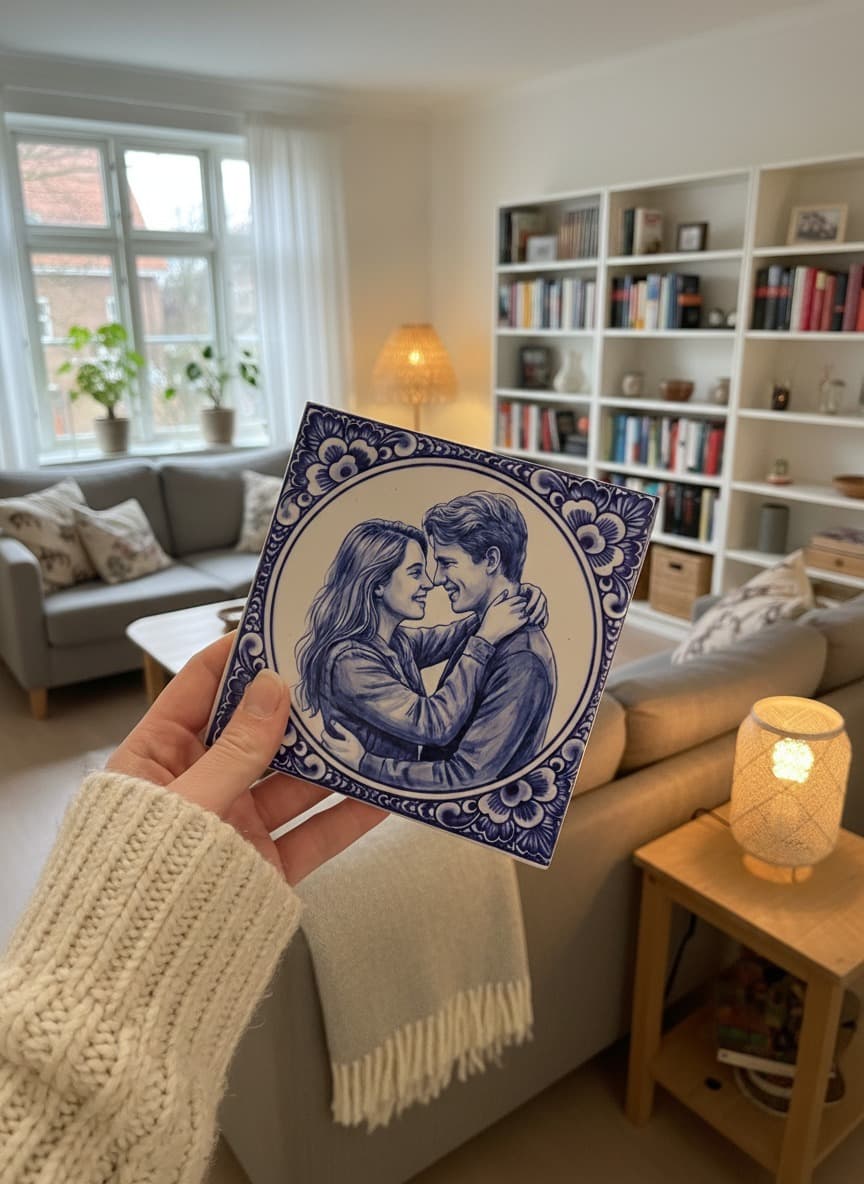
The third route skips the painting altogether: you supply a photo, it is converted into Delft blue style and fired onto a real ceramic tile. No brushwork, but a tile you can scrub.
What text should go on it?
A tile with text is a genre of its own — the tile saying. What works is shorter than people expect. Four lines is the maximum before it turns into an announcement rather than a tile, and each line runs out at around forty characters.
A few things that make the difference in practice:
- Short beats clever. A joke you have to read twice hangs badly on a wall.
- Names and dates are risky. They make it personal, but also impossible to move to another room or another life.
- Read it out loud. What looks good on a screen can sound like nothing on a wall.
If you want text only, with no photo, that is a separate product: the quote tile.
The birth tile
One of the few tiles with a fixed job. A birth tile generally holds the same things: name, date of birth, sometimes weight or time. It is one of the few gifts where dates really are in the right place — the date is the occasion.
We have a dedicated route for that: the new baby tile.
How we do it — and what it is not
This calls for an honest boundary, because it differs quite a bit from everything above.
We do not hand-paint anything. Your photo is converted digitally into a design in Delft blue style — the cobalt blue linework, the floral motifs, the corner ornaments — and that design is applied to a real glazed ceramic tile and fired in. So it sits under the glossy surface, not on it: no sticker, no foil. You can clean it with a damp cloth.
What it is not: it is not antique, it is not hand-painted, and it has no connection whatsoever to Royal Delft or De Porceleyne Fles. If you want a hand-painted piece, you want a pottery — that is a different product in a different bracket.


Which frame you choose changes the tile more than the photo does. A dense garland turns it into an ornament; an open field turns it into a portrait. There are fifteen, from classic round to ox-head and spider — names taken straight from the old corner motifs.
Frequently asked questions
Is a Delft blue tile made of porcelain?
No. It is earthenware with a white tin-glaze layer. Porcelain was not made in Europe until around 1709, well after Delft blue came about.
Can anyone put “Delft blue” on their product?
In practice “Delft blue” is a style label, not a certification mark — on its own it says nothing about where something was made or how. If you want a piece from a specific pottery, look for that company's name, not for the words “Delft blue”.
Can I fire a real Delft blue tile at home?
You can paint one; firing it under the glaze you cannot — that needs a ceramic kiln. Paint from the hobby shop stays on top of the glaze and stays fragile.
Why is cobalt always blue?
Cobalt is one of the few pigments that survives the heat of the glaze kiln without burning away. While you are painting it is grey-black; the blue only appears in the kiln.
Which photo works best?
A photo with clear light on the face and a quiet background. The conversion throws away all colour and keeps only light and dark, so a photo that relies on colour contrast comes out flat.
Want to see how your own photo turns out? You can do that straight away in the design studio — or take a look at all photo tiles first to compare the sizes side by side.